
Katy International & Interstate Child Custody Lawyer
When Custody Crosses State or Country Lines?
A custody case changes shape the moment a parent, or the child, crosses a state line or a national border. The real question stops being what feels fair to you and becomes which court actually has the authority to decide your child’s future.
A parent can sometimes file in Texas even after a child has already moved away. Timing alone can decide the whole case. An experienced child custody lawyer in Katy can work on cases involving Hague Convention return proceedings, interstate jurisdiction disputes, and cross-border support orders. When custody of your child is on the line, that experience matters.
Reach out to talk through where your case actually stands and what your options look like from here.
The Cross-Border Custody Problems We Help Katy Parents Sort Through
Families in and around Katy run into jurisdiction trouble in a handful of recurring situations. We regularly help with:
- Deciding which state should make the first custody ruling when parents live apart
- Modifying a custody order that was issued in another state
- Enforcing a Texas custody order against a parent who moved out of state
- Responding to a parent’s plan to relocate a child to another state or country
- Registering a custody order from another state or country so a Texas court can enforce it
- Seeking the return of a child taken to or from another country under the Hague Convention on international child abduction
Each of these situations turns on the same underlying question: which court has authority over your child.
Choosing the Right Court Matters
Jurisdiction disputes move faster than most parents expect, and delay can cost you the court you wanted. A Texas court generally has authority to make an initial custody determination if Texas is the child’s home state.
It can also have authority if Texas was the home state within the six months before the case started and a parent still lives in Texas. That rule comes from Tex. Fam. Code § 152.201, and it is the starting point for many interstate custody fights. Miss that window, or let a child stay too long in another state or country, and the other parent may be able to file in another jurisdiction instead.
Filing in the wrong county, or the wrong state, can mean starting over.
Katy International and Interstate Child Custody Lawyers Who Work These Specific Cases
Not every family lawyer handles Hague Convention petitions, home-state jurisdiction fights, and foreign support orders in the same caseload. We do.
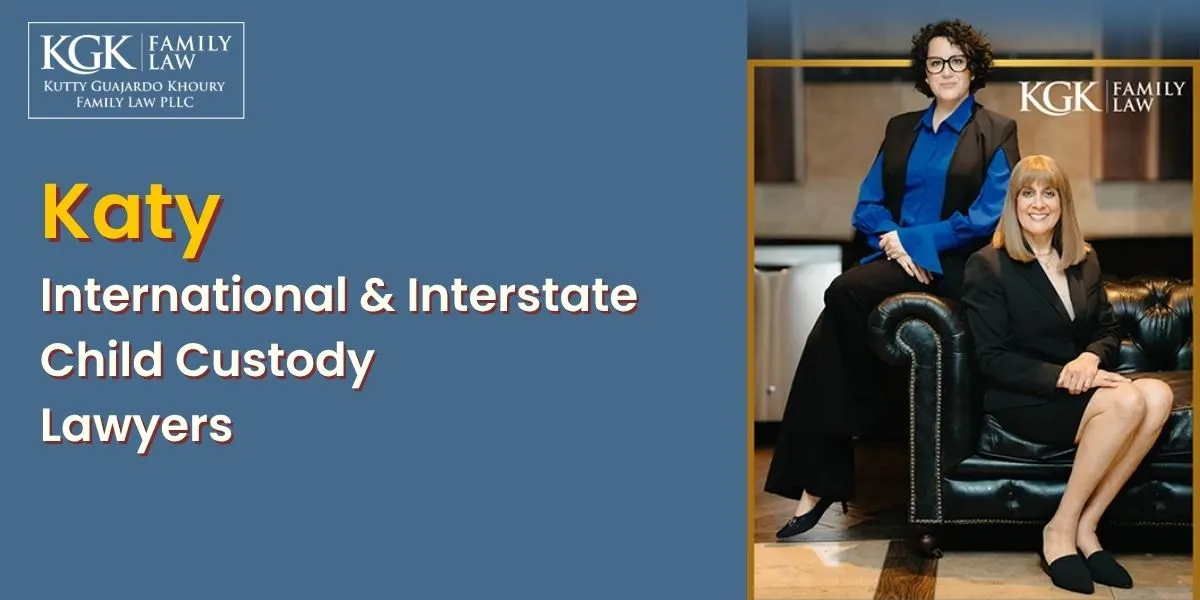
Denise Khoury’s practice includes high-conflict custody, multi-jurisdictional divorce, and cross-border enforcement work. She has been selected to Super Lawyers from 2020 through 2026. She also speaks English and Spanish. That matters when a case touches a Spanish-speaking country or a parent is more comfortable discussing the case in Spanish. Google reviewers have described how she guided a family through a complicated foreign child support matter with clear, steady communication.
Yasmin Kutty is board-certified in family law by the Texas Board of Legal Specialization, which is one of the highest distinctions for attorneys in the state of Texas. She has litigated high-conflict custody matters and has practiced law in New York.
Attorneys who have handled these jurisdiction and enforcement issues before know how to build the record a judge needs and act quickly when a child’s safety or location is at stake.
When a judge finds credible evidence of a real risk that a parent may take a child abroad and not return, the court can act to protect the child. The court can require the child’s passport be surrendered or can restrict travel under Tex. Fam. Code §§ 153.501, 153.503. We can help you ask a Texas court for those protections, or respond if someone is trying to use them against you unfairly.
Frequently Asked Questions
Which court will hear my case if I live in the Katy area?
It depends on your address. Katy stretches across Harris, Fort Bend, and Waller counties, and each county runs its own family courts. If your address falls on the Fort Bend County side, your case is filed with the Fort Bend County District Clerk and heard in Richmond. If you live in the Harris County part of Katy, your case goes to one of Harris County’s family district courts in Houston instead.
What happens if my co-parent already took our child to another country?
If the country is part of the Hague Convention on international child abduction, you may be able to file a return petition. That petition asks that country’s courts to send your child back to the United States. This process runs separately from a Texas custody case and moves on its own timeline. A lawyer familiar with these cases can help you figure out whether the treaty applies to the country involved.
Can my ex move our child to another state or country without my permission?
It depends on whether a court order is already in place. If a Texas order already restricts where the child can live, a move that breaks that restriction can be challenged in court. If no order exists yet, a parent generally cannot be legally stopped from moving on their own, but the move itself can affect the custody decision a judge eventually makes.
Will a custody order from another state or country be enforced in Texas?
Usually yes, once it is properly registered. Texas courts generally recognize and enforce custody orders made in another state or in a foreign country. That holds as long as the original court had proper authority when it made the order. Registering that order with a Texas court is typically the first step toward enforcing it here.
How long does an interstate or international custody case usually take?
It depends on how many states or countries are involved and whether the other parent contests jurisdiction. A straightforward modification within one state can resolve in a few months, while a contested jurisdiction fight or a Hague Convention return petition often takes much longer to work through.
What does it cost to work with a lawyer on a case like this?
Costs vary case by case. The number of jurisdictions involved, whether the other parent contests the case, and how much travel or foreign coordination is required all affect the total.
Why Katy Families Turn to an International and Interstate Child Custody Lawyer Now
Jurisdiction windows in custody cases do not stay open forever, and a parent who waits can lose the chance to have a Texas court decide the case at all. We work with Katy families on custody disputes that cross state and international lines, from Hague Convention matters to multi-state enforcement and foreign order registration.
Contact us today to schedule a consultation about where your case stands and what steps make sense next.

Houston
7700 San Felipe
STE 505
Houston, TX 77063
Fort Bend County / Sugar Land
12603 Southwest Fwy
STE 572
Stafford, TX 77477
Travis County Satellite Office
222 West Avenue
Austin, TX 78701

© Copyright 2026 KGK Family Law. All Rights Reserved.
*Images are obtained under license from Canva and other third-party stock image providers, with attribution included where required.
